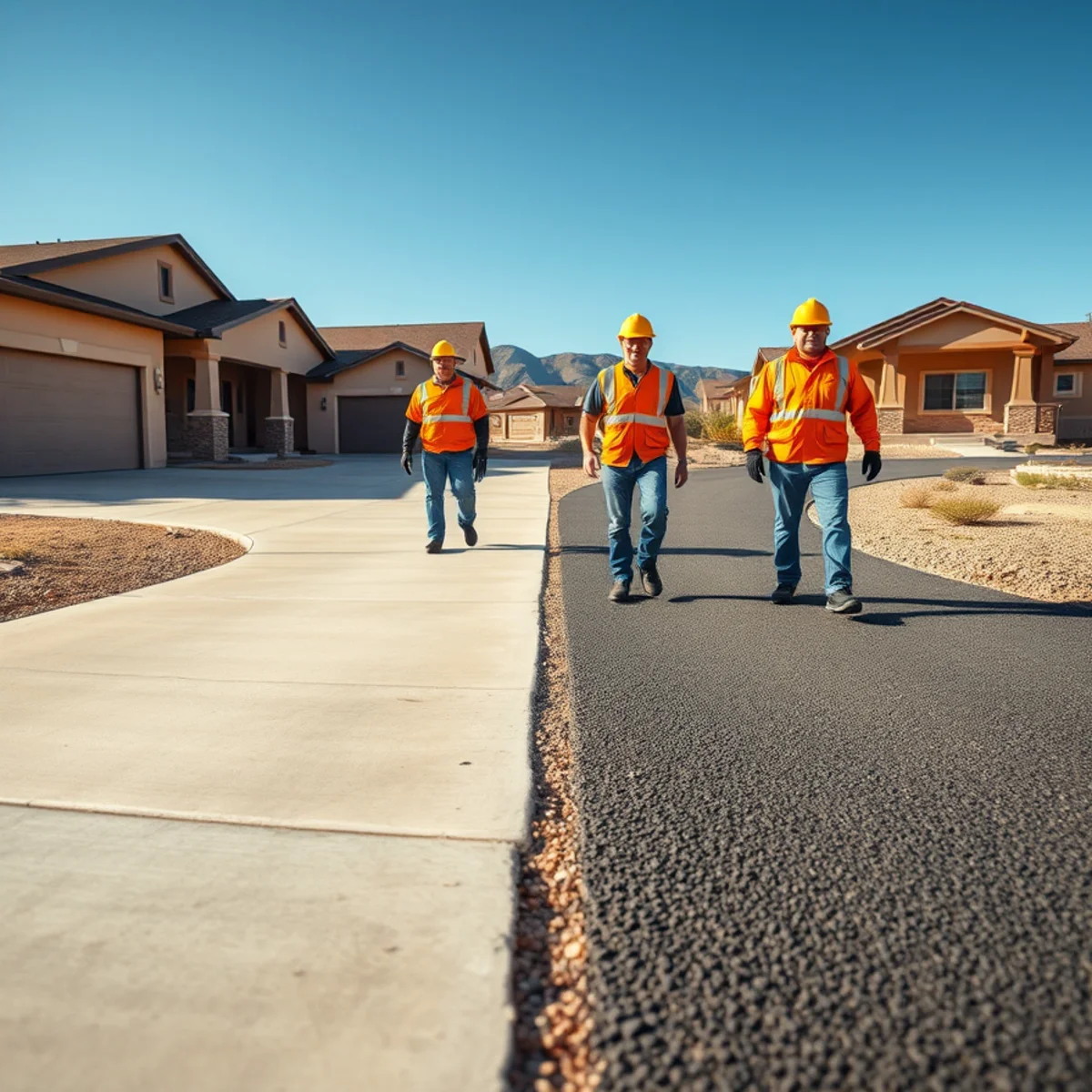
When it is time for a new driveway in Colorado, most homeowners narrow it down to two materials: concrete and asphalt. The honest answer to which lasts longer is concrete — by a wide margin. A well-built concrete driveway commonly lasts 30 to 40 years, while asphalt typically runs 15 to 20 before it needs replacing.
That does not make asphalt the wrong choice for everyone. It costs less up front, goes in fast, and handles cold-weather movement well. But in Pueblo's mix of freeze-thaw winters and 300-plus days of sun, the longer view usually favors concrete. Here is how the two really compare — on lifespan, cost, upkeep, and how each handles our climate.
The short answer: which lasts longer?
Concrete wins on longevity. Poured over a proper base with a 4,000 PSI air-entrained mix and sealed against salt, a concrete driveway routinely reaches 30 years or more in our climate. Asphalt, which relies on a petroleum binder that hardens and cracks with age and sun, generally gives you 15 to 20 years with regular upkeep. Over the life of your home, that often means one concrete driveway instead of two asphalt ones.
Concrete driveways: strengths and trade-offs
Concrete is the long-haul choice. It shrugs off summer heat without softening, carries heavy vehicles without rutting, and opens the door to color, stamping, and exposed aggregate finishes that asphalt simply can't match.
- Longest lifespan — 30 to 40 years when built and maintained right.
- Low maintenance — seal every few years; no annual fuss.
- Design options — natural gray, integral color, stamped patterns, exposed aggregate.
- Stays firm in heat — no softening under our high-desert summer sun.
- Resale appeal — buyers read a concrete driveway as premium and long-lived.
The main trade-offs are a higher up-front cost and sensitivity to deicing salt. Both are manageable: an air-entrained mix and a penetrating sealer handle the salt, and the longer lifespan offsets the price. If a sound slab ever settles unevenly on our clay, concrete leveling can lift it back into place instead of replacing it.
Asphalt driveways: strengths and trade-offs
Asphalt earns its place on cost and speed. It is cheaper to install, can be driven on within a day or two, and its flexibility helps it ride out the ground movement that freeze-thaw brings.
- Lower up-front cost — the budget-friendly option to install.
- Fast to install and use — usable in a day or two.
- Flexes in cold — the binder gives slightly instead of cracking.
- Simple repairs — cracks and surfaces are easy and cheap to patch or resurface.
The catch is upkeep and lifespan. Asphalt needs sealcoating every two to four years, softens and can rut under intense summer sun, and simply does not last as long. It also comes in one color — black — with no decorative options.
Concrete vs. asphalt, side by side
| Factor | Concrete | Asphalt |
|---|---|---|
| Lifespan | 30–40 years | 15–20 years |
| Up-front cost | Higher | Lower |
| Maintenance | Seal every few years; low effort | Sealcoat every 2–4 years; periodic patching |
| Colorado climate | Great in heat; seal against salt and freeze-thaw | Flexes in cold; can soften in summer sun |
| Resale appeal | Higher — reads as premium | Functional; shorter life is a factor |
| Look and options | Color, stamping, exposed aggregate | Black only, uniform finish |
How Colorado's climate factors in
Our climate is tough on both materials, just in different ways. Freeze-thaw cycles heave the ground under any driveway, which is why a compacted base matters more here than the surface you choose. Asphalt's flexibility helps it cope with that movement, but our summer sun and UV bake its binder and shorten its life. Concrete stands up to heat and sun beautifully; its weak point is deicing salt, which an air-entrained mix and regular sealing keep in check.
The takeaway: neither material fails because of Colorado weather alone — they fail from a skipped base, the wrong mix, or missed maintenance. Build it right and keep it sealed, and concrete gives you the longer, lower-worry road.
Cost over the life of the driveway
Asphalt almost always wins the up-front price, and if the lowest initial cost is the priority, it is hard to beat. But stretch the math across 30 years and the picture shifts. In that window you might resurface or replace asphalt at least once and sealcoat it many times, while a single concrete driveway keeps going on a seal every few years.
For current concrete ranges by finish and size in our area, see our Pueblo driveway cost guide. Prices there are general ranges for planning; your exact number is confirmed on a free on-site estimate, and our expansive soils can raise base-prep costs versus national averages.
Whichever you choose, protect it from salt
Our take for Pueblo homeowners
If you plan to stay in your home and want the longest life with the least maintenance, concrete is usually the better investment here — and it is what we build. We pour concrete driveways across Pueblo and Pueblo West with a proper base, a 4,000 PSI air-entrained mix, and a sealed finish made for our winters. If your current driveway is cracked or sunken rather than worn out, we will tell you honestly whether concrete repair or a lift makes more sense than a full replacement. For a free estimate, call (833) 334-0468.
Frequently asked questions
Written by M.A.M. Concrete
A locally owned concrete contractor pouring driveways, patios, and foundations across Pueblo County & Southern Colorado. We write what we know from the job site.
Services mentioned in this article
Concrete Driveways
New driveways, replacements, and widening — poured with a 4,000 PSI air-entrained mix built for Pueblo freeze-thaw.
Learn moreConcrete Repair
Concrete crack repair, spalling, and resurfacing in Pueblo — we fix the cause, not just the symptom, and tell you when to repair vs. replace.
Learn moreConcrete Leveling & Mudjacking
Sunken concrete leveling and mudjacking in Pueblo — raise driveways, walkways, and patios for a fraction of replacement cost, often in a day.
Learn more