Freeze-thaw is the number one reason exterior concrete fails in Pueblo — and it isn't our coldest morning of the year that does the damage. It's the constant cycle of freezing and thawing that runs from October through April. A slab can look perfect in September and start flaking by March if it was poured wrong or never sealed.
The good news: freeze-thaw damage is almost entirely preventable. The right mix, a properly compacted base, and a coat of penetrating sealer will carry a driveway or sidewalk through decades of Pueblo winters. This guide walks through exactly how the damage happens — and the specific steps that stop it.
What freeze-thaw actually does to concrete
Concrete looks solid, but it's full of microscopic pores. When it rains or snow melts, those pores soak up water like a sponge. When the temperature drops below freezing, that trapped water turns to ice — and ice takes up about 9 percent more space than liquid water. The expansion has nowhere to go, so it pushes outward against the surrounding concrete from the inside.
One freeze won't hurt a healthy slab. The problem is repetition. Every cycle drives water a little deeper and pries the structure apart a little more. Do that a few dozen times a winter, year after year, and the surface starts to give up — first as fine flaking, then as larger pieces breaking loose.
Why Pueblo is harder on concrete than its temperature suggests
Pueblo isn't International Falls — our winters are relatively mild, with more than 300 days of sunshine a year. That sunshine is exactly the problem. A sunny 45-degree afternoon melts the snow on your driveway; a clear night drops into the 20s and refreezes it. That single-day swing is one full freeze-thaw cycle, and we rack up dozens every season. Concrete that simply stays frozen all winter often fares better than ours.
Scaling and spalling: the damage you will actually see
Freeze-thaw shows up in two classic ways, and it helps to know the difference when you are sizing up your own slab:
- Scaling is surface damage — the top layer flakes, peels, or sheds a thin crust, often leaving the sand and small stones exposed. It usually starts in the areas that stay wettest or get the most deicer.
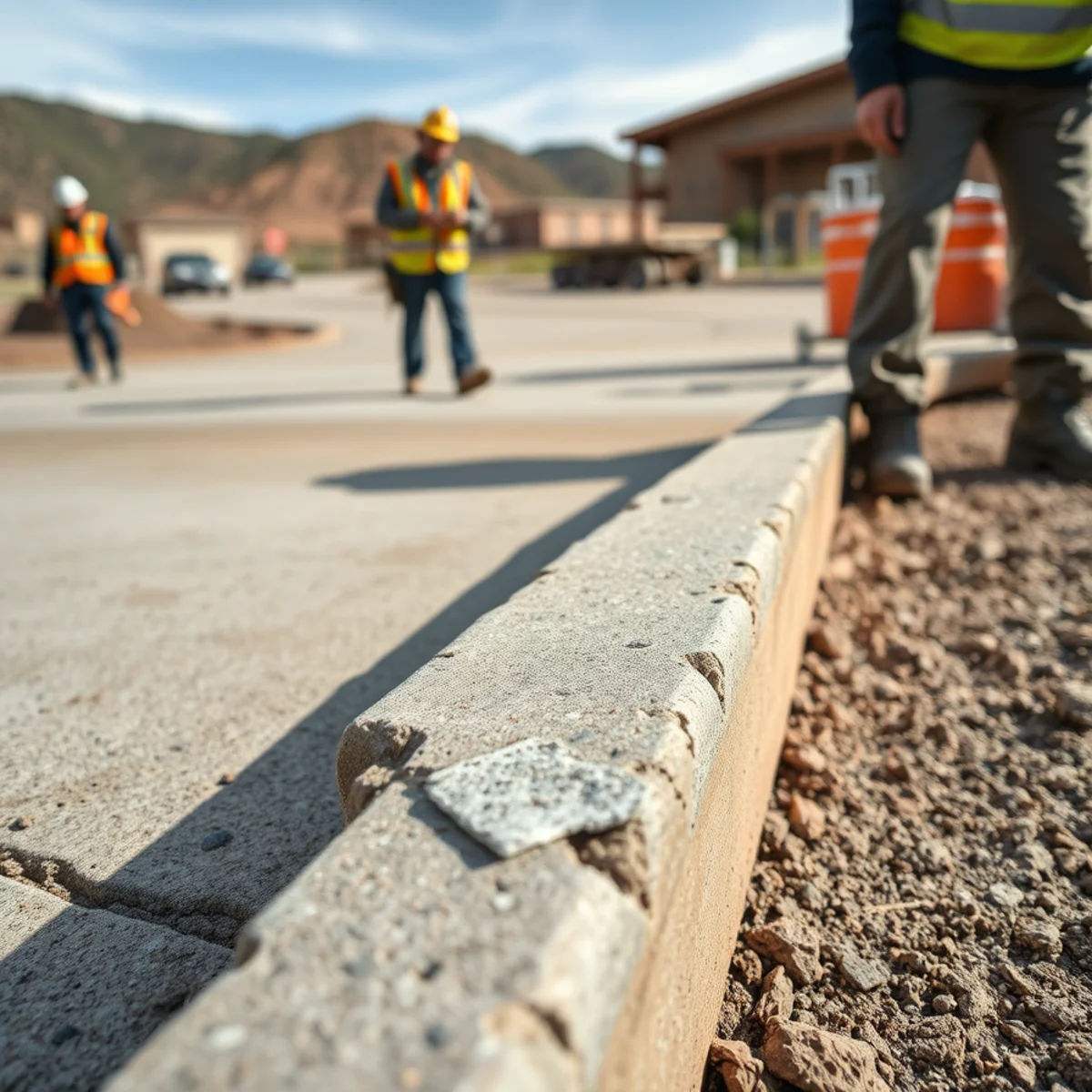
- Spalling goes deeper — chunks and flakes pop loose, leaving shallow craters and sometimes exposing the steel reinforcement below. Spalling around joints and edges is especially common, because those spots hold water.
Both tend to appear first on north-facing slabs and shaded walkways that never fully dry out, and around downspouts where runoff concentrates. If it spreads a little more each spring, the slab is soaking up water it should be shedding.
Air-entrained concrete: the single most important defense
The best protection against freeze-thaw is built into the concrete before it ever leaves the truck. Air-entrained concrete contains billions of microscopic air bubbles, created by an admixture added at the plant. Those bubbles act as tiny pressure-relief chambers: when trapped water freezes and expands, it pushes into the nearest air pocket instead of cracking the concrete around it.
This is why we pour every exterior surface — driveways, sidewalks, patios, and steps — with a 4,000 PSI air-entrained mix. It's the standard for flatwork in any freeze-thaw climate, and skipping it is the most common corner we see cut on failed slabs around town. Interior concrete doesn't need it, but outdoors in Pueblo, it isn't optional.
The catch with air entrainment
Sealing: cheap insurance that pays off
If water can't get in, it can't freeze inside your concrete. A penetrating sealer soaks into the surface and lines those pores so they shed water instead of drinking it in. Unlike a glossy topical coating that sits on top and can peel, a penetrating silane or siloxane sealer breathes — it keeps liquid water out while letting the slab release vapor, so you don't trap moisture underneath.
We seal new flatwork once it has cured, then recommend resealing every two to three years — sooner on a driveway that takes heavy sun and traffic. It's one of the cheapest, highest-return things you can do for concrete. Our guide to sealing a concrete driveway in Colorado covers timing and products in more detail.
Why deicing salt makes freeze-thaw worse
Reaching for the ice melt feels harmless, but deicing salts quietly accelerate freeze-thaw damage — they pull extra moisture into the slab and lower its freezing point, driving more thaw-and-refreeze cycles. New concrete is the most vulnerable, so the hard rule is no deicing salt on any slab through its first full winter. After that, use it sparingly; plain sand gives traction without the chemistry. Our post on deicing salts versus concrete goes deeper.
Protecting the concrete you already have
Even without a repour, a few habits go a long way in our climate:
- Keep water moving away — clear downspout extensions, and don't let sprinklers soak the slab.
- Shovel snow off promptly instead of letting it melt and refreeze in place.
- Skip the rock salt; use sand for traction, especially through the first winter.
- Reseal every couple of years, and fill small cracks before water can get into them.
- Keep control joints and edges caulked so they don't collect standing water.
When freeze-thaw damage is already done
Caught early, surface scaling can often be resurfaced and sealed before it spreads. Once spalling is deep, widespread, or reaching the reinforcement, patching becomes a losing battle and replacement is the better value. Our concrete repair crew can tell you honestly which side of that line your slab is on. When it's time for new flatwork, we rebuild concrete driveways and sidewalks and walkways the way they should have been done the first time — right mix, right base, sealed and ready for winter.
We handle freeze-thaw repair and replacement across Pueblo, Cañon City, and the surrounding Southern Colorado communities.
Pueblo winters are hard on concrete, but they don't have to win. Whether you want a tired slab assessed or a new one poured to survive the next 30 winters, M.A.M. Concrete is happy to take a look. Estimates are always free, we offer a 10% veteran discount, and you'll get a straight answer about what your concrete actually needs. Call (833) 334-0468 to set up your free on-site estimate.
Frequently asked questions
Written by M.A.M. Concrete
A locally owned concrete contractor pouring driveways, patios, and foundations across Pueblo County & Southern Colorado. We write what we know from the job site.
Services mentioned in this article
Concrete Repair
Concrete crack repair, spalling, and resurfacing in Pueblo — we fix the cause, not just the symptom, and tell you when to repair vs. replace.
Learn moreConcrete Driveways
New driveways, replacements, and widening — poured with a 4,000 PSI air-entrained mix built for Pueblo freeze-thaw.
Learn moreConcrete Sidewalks & Walkways
Level, slip-resistant front walks, garden paths & ADA routes — poured with control joints and drainage that beat trip hazards.
Learn more