Here's something most contractors won't lead with: almost all concrete cracks, and a lot of the time that's completely normal. Concrete shrinks as it cures and moves with temperature and soil, and those forces have to go somewhere. The real question is never whether your concrete will crack — it's which kind of crack you're looking at.
Most cracks are cosmetic and harmless. A few are early warnings worth taking seriously. This guide sorts one from the other so you know when to shrug, when to seal, and when to call someone out — with the specific stresses Southern Colorado puts on concrete in mind.
First, the truth: nearly all concrete cracks
Concrete is enormously strong when you push on it and surprisingly weak when you pull it apart — strong in compression, weak in tension. As a fresh slab cures, it loses moisture and shrinks slightly, and that shrinkage puts the surface in tension. Add our temperature swings and shifting soils, and some cracking is simply the material doing what it does. A skilled crew doesn't promise crack-free concrete. It controls where the cracks happen so they're straight, hidden, and harmless.
The common, harmless cracks
Shrinkage cracks
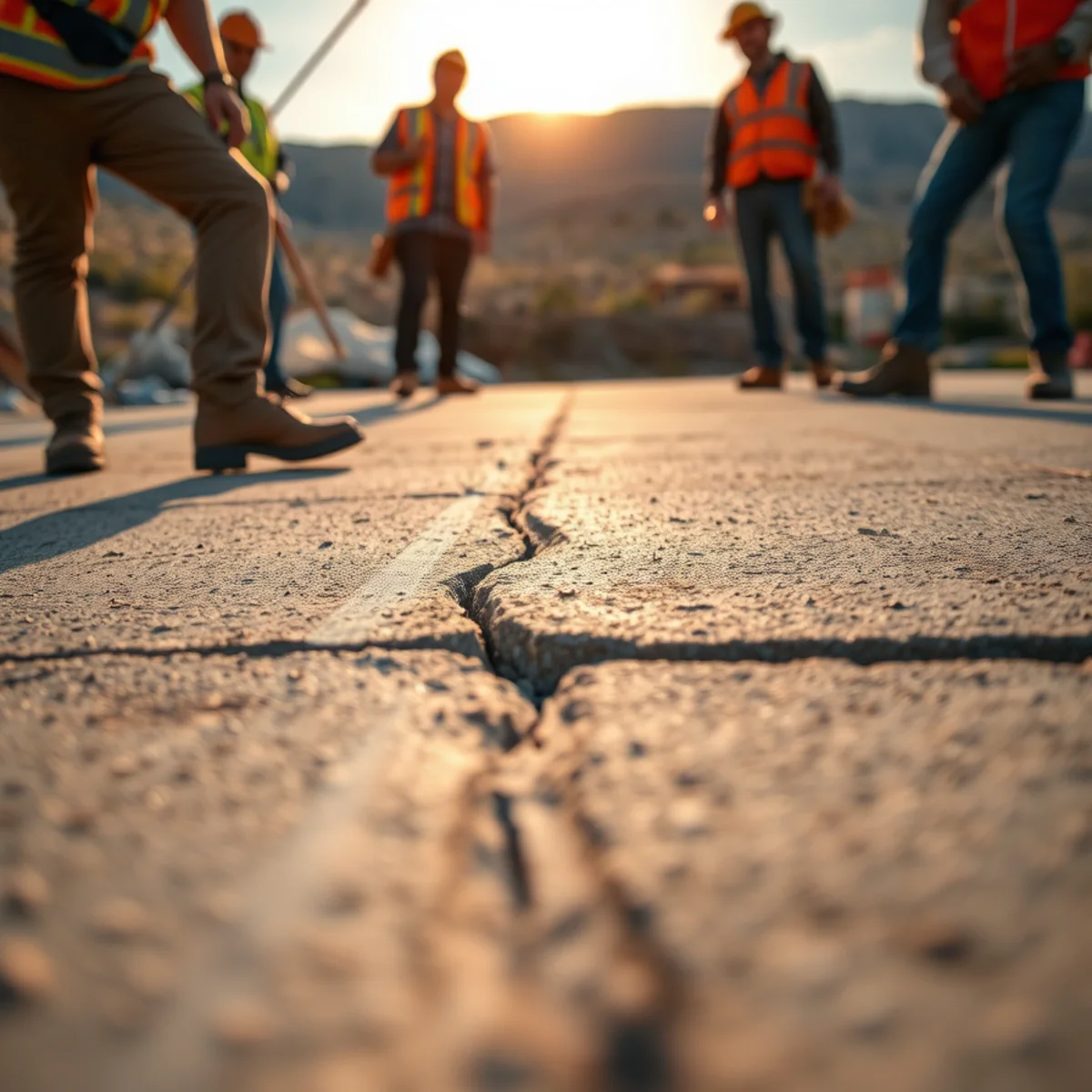
These are the everyday cracks — thin, often running along or near the joints, appearing in the first weeks or months as the slab gives up moisture. They rarely go all the way through, they don't widen much, and they don't threaten the slab. Sealing them keeps water out, and that's usually the end of the story.
Crazing and surface cracks
Crazing looks like a fine spiderweb or dried-mud pattern across the surface. It forms in the very top layer during finishing and never reaches the body of the concrete. It is purely cosmetic — no structural meaning at all — though sealing evens out the look and protects the surface.
Cracks that follow the joints
If a crack runs neatly down a tooled or sawn groove, that is the slab working exactly as designed. Those grooves are there to attract the crack. A crack in the joint is a success, not a defect.
Control joints: cracks by appointment
Since concrete is going to shrink and crack, we decide in advance where. Control joints are the straight grooves we tool or saw into a slab — deliberate weak lines that give the shrinkage somewhere to release. The concrete cracks along that hidden line instead of wandering across the middle of your driveway. As a rule of thumb, joints are spaced in feet at roughly two to three times the slab thickness in inches, so a four-inch slab gets joints about every 8 to 12 feet, plus isolation joints where the slab meets a foundation or step.
Good jointing is one of the clearest marks of an experienced pour, and it matters even more here, where daily temperature swings and expansive soils are constantly nudging the slab. Skimp on joints and the concrete makes its own — usually somewhere you won't like.
The cracks that signal a real problem
Some cracks are telling you something is moving underneath or the concrete is under stress it was never meant to carry. Take a closer look if you see:
- Cracks wider than about a quarter inch, especially if they're still opening up
- One side sitting higher than the other — a lip or trip hazard means the slab has heaved or settled
- Cracks that measurably widen or lengthen from season to season
- Horizontal or stair-step cracks in a foundation wall
- Cracks that leak or stay damp, letting water reach the base and reinforcement
Mark it and watch it
Why Southern Colorado is tough on concrete
Our region stacks several crack-driving forces on top of ordinary shrinkage. Freeze-thaw cycles pry at the surface all winter. Expansive clay soils swell and shrink with moisture, heaving and settling slabs from below. Big day-to-night temperature swings expand and contract the concrete daily, and 300-plus days of dry, high-desert sun pull moisture out fast during curing.
Two of these deserve their own reading if you want the full picture: our guides on how freeze-thaw cycles damage concrete and expansive soil under Pueblo County foundations explain the mechanisms and the fixes.
Cosmetic or serious? A quick gut check
When in doubt, this is the read we use in the field:
| What you see | Likely cause | Worry level |
|---|---|---|
| Hairline cracks along the joints | Normal shrinkage | Low — cosmetic |
| Fine spiderweb surface pattern | Crazing during finishing | Low — cosmetic |
| Crack under a quarter inch, level and stable | Shrinkage or minor movement | Low — seal and monitor |
| Crack wider than a quarter inch or growing | Soil movement or overload | Higher — get it assessed |
| Uneven sides or a trip lip | Heave or settlement | Higher — leveling or repair |
| Stair-step cracks in a foundation wall | Structural or soil movement | High — assess promptly |
What to do about the cracks you have
Cosmetic cracks still deserve attention in our climate — sealing them keeps water out so freeze-thaw can't widen them over the winter. A slab that has settled unevenly is often a candidate for concrete leveling rather than replacement, which lifts it back to grade for a fraction of the cost. When cracking is wide, active, or paired with real movement, concrete repair or a fresh pour is the honest answer, and we'll tell you which it is. Badly cracked concrete driveways are one of the most common projects we take on.
We diagnose and fix cracked concrete throughout Pueblo, Colorado City, and the surrounding communities.
If a crack has you second-guessing, don't sit on it wondering — a quick look usually settles it. We're happy to come out, tell you whether it's cosmetic or something to address, and lay out your options with no pressure. Estimates are always free, and we offer a 10% veteran discount. Call (833) 334-0468 to schedule your free on-site assessment.
Frequently asked questions
Written by M.A.M. Concrete
A locally owned concrete contractor pouring driveways, patios, and foundations across Pueblo County & Southern Colorado. We write what we know from the job site.
Services mentioned in this article
Concrete Repair
Concrete crack repair, spalling, and resurfacing in Pueblo — we fix the cause, not just the symptom, and tell you when to repair vs. replace.
Learn moreConcrete Driveways
New driveways, replacements, and widening — poured with a 4,000 PSI air-entrained mix built for Pueblo freeze-thaw.
Learn moreConcrete Leveling & Mudjacking
Sunken concrete leveling and mudjacking in Pueblo — raise driveways, walkways, and patios for a fraction of replacement cost, often in a day.
Learn more